
Prof. Dr. Beatriz Roldán Cuenya
The goal of A04 is the fundamental understanding of the reactivity-, selectivity- and stability-determining properties of tailored model catalysts for oxidation reactions in the liquid phase. In particular, we aim to contribute to a better understanding of the role of frustrated phase transitions within liquid oxidation electrocatalysis by studying the kinetically determined transformations upon material exposure to catalytic conditions. The main objective is to identify the most important design principles of improved (electro)catalysts for liquid-phase oxidation reactions allowing a facile, sustainable active site formation under reaction conditions and being characterized by long activity periods. Additionally, we aim to improve the current knowledge of kinetically driven deactivation processes. Therefore, we will employ correlative (quasi-in situ, in situ and operando) spectro-microscopy investigations to identify material modifications as a response to changes in the local chemical potential during the reaction under steady-state operation. In addition, we will explore the additional influence of continuous and periodic changes in the temperature and electrical potential.
The structure, morphology, bulk and near-surface composition of well-defined pre-catalyst materials will be first studied quasi-in situ before and after electrocatalysis to unveil the main differences in the activity, selectivity and stability. Subsequently, the best performing materials will be subjected to an in depth in situ and operando characterization. We will study defect-engineered electrode materials to link the abundance and stability of distinct compositional and structural imperfections such as metal and oxygen vacancies with catalytic performance. Our target materials will be Co3O4-based nanoparticle (NP) and epitaxial thin film (e-TF) catalysts with Ni- and Cu-containing oxide overlayers of varying thicknesses to ensure relevant catalytic performance towards ethanol (electro)oxidation. To this end, a large set of (surface- and bulk-sensitive) operando methodologies including X-ray-based structural characterization, vibrational spectroscopy as well as electron and scanning probe microscopy will be applied. These studies will be complemented by quasi-in situ pre- and post-catalysis characterization using a variety of surface science methods. We will closely collaborate within the consortium to support and verify our findings with theoretical calculations and (operando) insights obtained by other groups on selected thin film oxide catalysts.
Following the success of our interactions within the CRC, we will continue to apply our methodology to selected thin films and nanoparticles of the CRC. We expect to extend the knowledge we obtained during the 2nd funding period (FP2) regarding structure-activity relationships for the initial pre-catalyst state by a deepened insight into the working catalyst's operation mode and progress towards a deeper understanding of the solid-liquid interface during oxidation catalysis under extended operation, focusing on unveiling the origin of the materials’ deactivation leading to a better materials design through the active site stabilization.
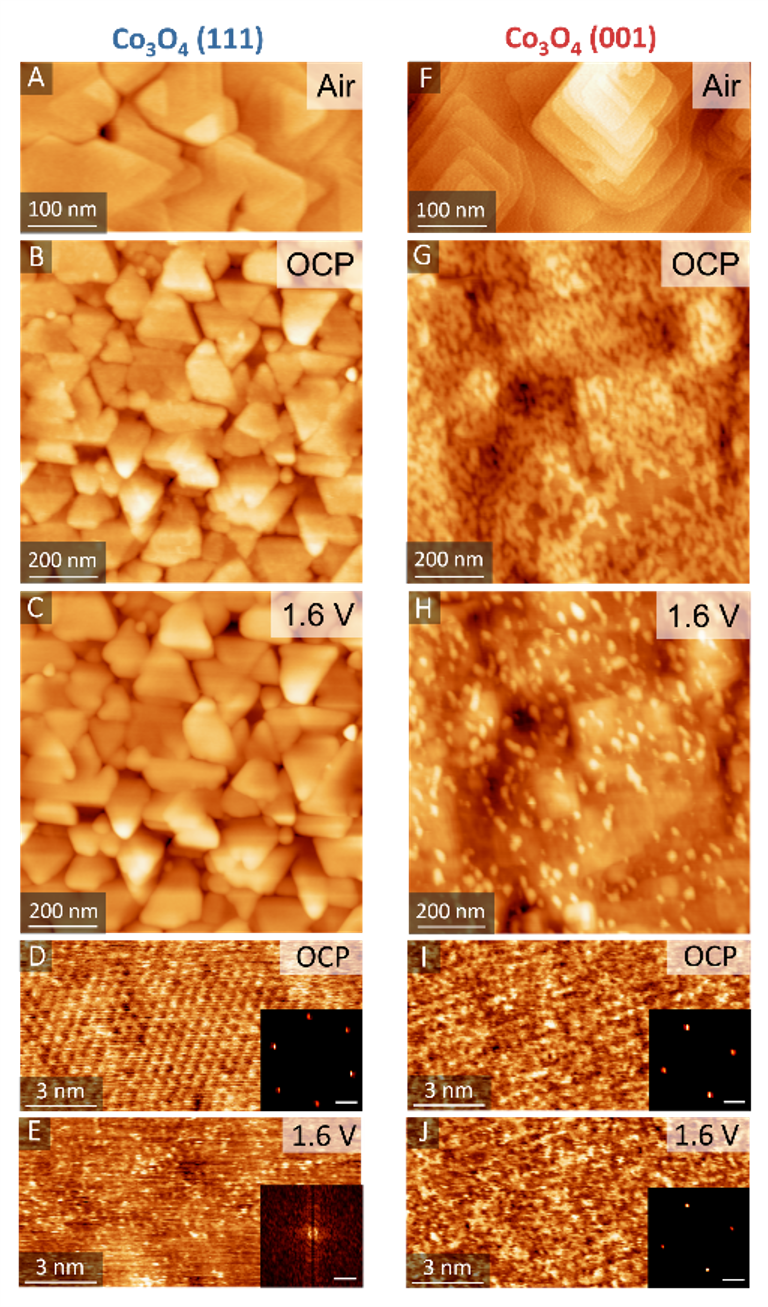
Figure: In situ AFM during OER Micrographs of (A‑E) Co3O4(111) and (F-J) Co3O4(001) thin film surfaces in air, at open circuit potential and during OER, latter two conditions with lower and higher magnification. FFT images of the high-resolution AFM images shown as insets.
A04: Surface Reactivity of Model Oxide Catalyst
The goal of this project is the fundamental understanding of structure/reactivity/stability relationships for well-defined oxidation model catalysts in the liquid phase. We will perform surface-sensitive time-resolved operando studies for in situ grown epitaxial thin films, TFs (Co3O4, Fe3O4, CoFe2O4, VCo2O4 and LaCoO3) and nanoparticle (NP) analogues during alcohol oxidation (electrocatalytic and thermal liquid-phase) and the electrocatalytic oxygen evolution reaction (OER). The epitaxial TFs ensure full experimental control and access to the surface properties on the atomic scale, while having the required conductivity for electrochemistry investigations. We will study the catalytic role of the surface orientation, of modifiers in a wide range of concentrations and of deliberately introduced defect motifs in order to elucidate their effect on the active state properties under reaction conditions. We will reveal how the catalyst (de)activates under reaction conditions and how the surface structure and the composition of the pre-catalyst affect this.
To this end we will apply surface-sensitive operando methodology such as grazing-incidence X-ray methods (X-ray absorption spectroscopy (XAS) and X-ray diffraction (XRD)) and (surface-enhanced) Raman spectroscopy. These studies will be backed up by in situ pre and post catalysis characterization using a variety of surface science methods like LEED, XPS/LEIS, AFM and STM. We will closely collaborate within the consortium to support and verify our findings with theoretical calculations and (operando) insights obtained by other groups. We expect to extend the knowledge we obtained during the 1st funding period regarding structure-activity relationships for the initial pre-catalyst state by a deepened insight into the working catalyst’s operation mode, and progress towards a holistic understanding of the solid-liquid interface during oxidation catalysis under static and dynamic operation conditions.

Copyright © TRR247 2026
Last update: Jul 28, 2026
