
Prof. Dr. Malte Behrens • Jun.-Prof. Dr. Huayna Terraschke
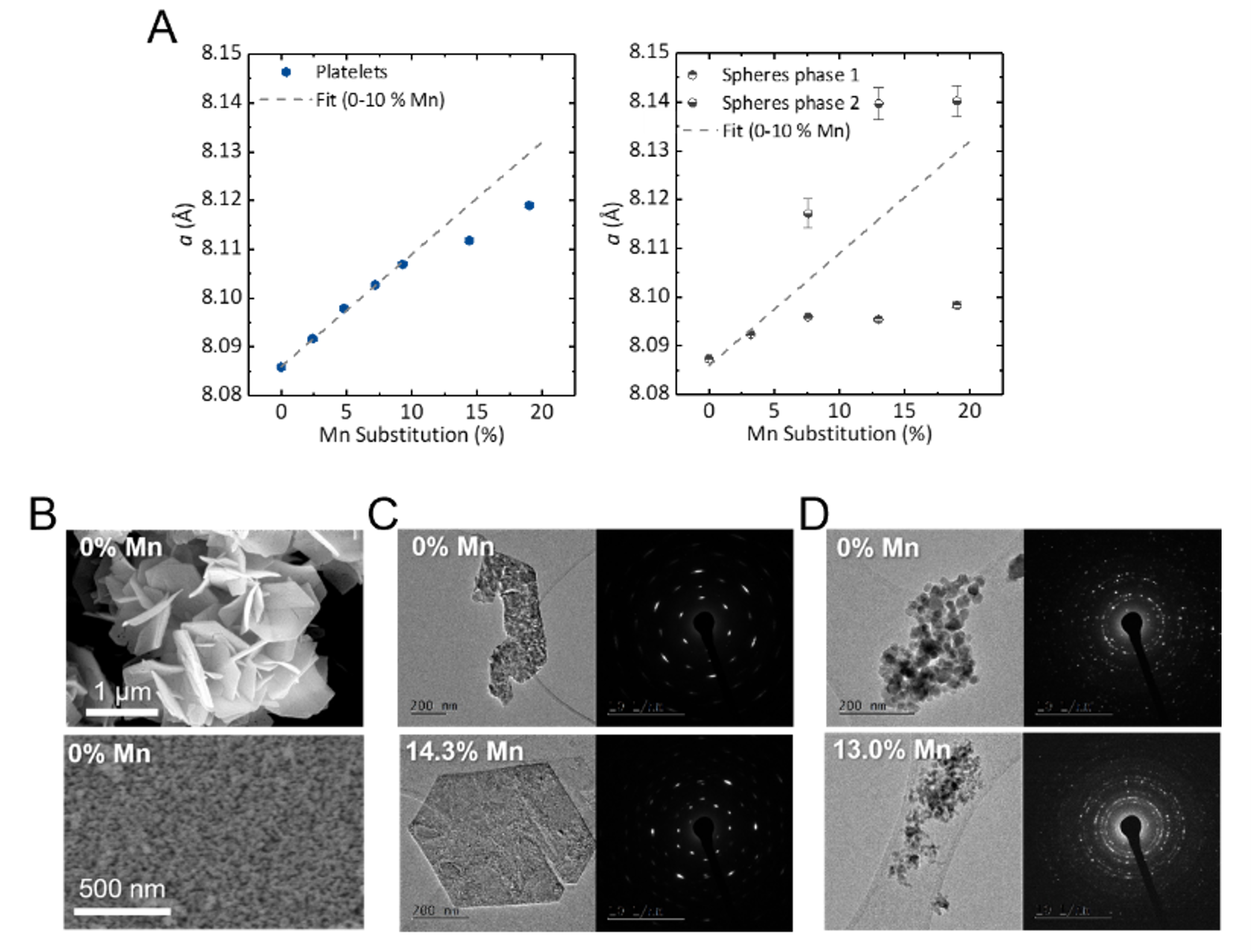
In C01, syntheses for cobalt oxide catalysts with a controlled defect structure and cation and anion doping will be developed based on the crystalline precursor decomposition (CPD) approach established in FP1 and FP2. The project will provide high-performance catalysts, focusing on co-precipitated doped materials using V, Mn, Fe, and Ni as cation dopants to the CRC and receiving feedback from Area A and Area B for a rational iterative optimization. In FP3, a new focus will be placed on anion substitution/doping via oxy-nitride synthesis using ammonolysis as post-treatment. In addition, all stages of synthesis will be deeply characterized with in situ-synchrotron diffraction and total scattering, helping to understand the wet chemical steps. As a new method to visualize surface intermediates of working oxidation catalysts to enable improved spatio-temporal observations, chemiluminescence spectroscopy and microscopy will be developed and applied. This activity follows the concept of “cataluminescence”, commonly used in volatile organic compound (VOC) sensor systems, and extends it into a tool to understand catalytic reactions. By monitoring dynamic reaction conditions, changes in the photoluminescence (PL) spectra will provide signatures of specific surface intermediates. In addition, luminescent catalysts will be developed by doping with 4f elements such as Yb3+. The PL of the 4f dopants is sensitive to its local coordination and can be used as a probe for the structural dynamics of the catalyst induced by the reaction conditions, such as (frustrated) phase transitions. All dopants will be studied in collaboration with Area B to understand their effect on phase changes of the doped materials under relevant conditions and in collaboration with Area A regarding their catalytic properties.
Figure: Mn-doped Co3O4 spinels with isotropic and anisotropic morphology. (A) Lattice parameters of doped spinels obtained as platelet (left) or spherical particles (right). (B) SEM and (C,D) TEM images with selected area electron diffraction patterns for different Mn doping levels.
C01: Synthesis of Transition Metal Oxides with Controlled Mesostructure
The project aim is the development of pristine mesostructured cobalt oxide with tunable morphology as well as preparation of iron, vanadium and manganese incorporated in its crystal structure via hard templating and post-treatment processes. This synthesis concept is complemented by the crystalline precursor decomposition approach, which focuses on precursor deposition on surfaces to make well-defined powder layers accessible for surface science studies. The project builds upon the results of the first funding period, where the effects of morphology and iron doping/substitution have been successfully established. Vanadium and manganese have ability to adopt multiple high oxidation states and their combination with cobalt oxide is expected to tune its crystal, electronic and band structures among other physicochemical properties. The influence of this kind of alteration will be investigated for liquid phase catalytic transformation reactions by focusing on oxygen evolution half reaction of water electrolysis on the one hand, and on aerobic 2-propanol oxidation on the other hand. The electrocatalysts alteration will be monitored under working condition by coupling Raman Microscopy with Inductively Coupled Plasma Optical Emission Spectrometry (ICP-OES). The thermal catalysis tests will be conducted in the presence of steam to study the effect of solvents.
This study will allow gaining insights about phase transformation and compositional change of electrocatalysts and thermal catalysts, their activation or deactivation as well as determination of active centers. This synthesis project will play a central role within the consortium; the prepared and well-characterized selected samples will be delivered to partners in Areas A and B for in-deep structural analyses and catalytic investigations. At the same time, the successful materials basis of the first funding period, e.g., the Co-Fe systems, will remain accessible for in-depths studies.

Copyright © TRR247 2026
Last update: Aug 17, 2026
